.png)

TL;DR:
- Most digital ad spend is lost due to ads that fail to convert, not targeting issues.
- Effective ads require clear messaging, targeted audiences, and continuous testing across formats.
- Ongoing analysis and optimization of creatives, landing pages, and audiences are key to maximizing ROAS.
Most digital ad budgets bleed out quietly. Not from bad targeting or wrong platforms, but from ads that simply fail to convert. You get the clicks, you pay for the impressions, and then nothing happens. The disconnect between ad spend and actual revenue is one of the most expensive problems eCommerce and DTC brands face today. Many brands struggle to scale because their creative strategy is built on guesswork rather than proven conversion principles. This guide walks you through the fundamentals, preparation, execution, and ongoing optimization you need to build ads that actually move product and maximize your return on ad spend.
| Point | Details |
|---|---|
| Know your metrics | Success starts with understanding conversion rates, ROAS, and tracking key ad KPIs. |
| Preparation is crucial | Efficient ad creation relies on clear targeting, compelling creative assets, and robust analytics setup. |
| Follow proven steps | Step-by-step execution ensures ads are built and launched for maximum impact and conversion. |
| Analyze and optimize | Regular analytics reviews and A/B testing improve conversion results and reveal winning ad strategies. |
| Continuous learning wins | Long-term conversion growth comes from iterative learning and adaptation to market feedback. |
Before you can fix what’s broken, you need to know what you’re measuring. Three numbers matter most in paid advertising: conversion rate (the percentage of people who take the desired action after seeing your ad), click-through rate or CTR (how often people click your ad versus how many see it), and ROAS (return on ad spend, meaning how many dollars you earn for every dollar spent). These aren’t just vanity metrics. They tell you exactly where your funnel is leaking.
Message clarity and targeting are the two biggest levers most brands underuse. An ad shown to the wrong audience will always underperform, no matter how good the creative is. And even a perfectly targeted ad will fail if the message is vague, confusing, or fails to address a real pain point. The conversion optimization guide from Digital Marketing All breaks down how message-to-market match is the single most important factor in ad performance.
Here are the primary ad formats and their key trade-offs:
| Ad format | Best for | Weakness |
|---|---|---|
| Static image | Quick testing, direct offers | Lower engagement ceiling |
| Video | Brand storytelling, demos | High production cost |
| Carousel | Product range, feature lists | Requires strong visuals |
| UGC-style | Trust building, cold traffic | Harder to control quality |
| Advertorial | Complex products, cold audiences | Longer funnel, slower results |
Using direct response ad creative as your framework matters more than the format you choose. Direct response ads built around a specific offer, audience pain point, and clear call to action yield up to 62% higher conversions compared to brand-awareness style creative in health and eCommerce categories.
Pro Tip: Track your metrics at the ad level, not just the campaign level. Aggregated data hides which specific creative is driving results and which is draining budget.
Great ads don’t start with a blank canvas. They start with research. Before you write a single word of copy or brief a designer, you need to know exactly who you’re talking to, what they’re afraid of, what they want, and what objections they’ll raise before buying. Persona research is not optional. It’s the foundation everything else is built on.
Your toolkit for building high-converting ads should include a creative brief template, a swipe file of winning ads in your category, a copywriting framework (Problem-Agitate-Solution works well for most DTC offers), and access to your analytics platform. Tools like Meta Ads Manager, TikTok Ads Manager, and Google Ads all have built-in audience insight features that are underused by most brands.
Here are the five essential ingredients every high-converting ad must have:
| Element | Why it matters | Common mistake |
|---|---|---|
| Copy | Drives emotional connection and urgency | Too generic, no clear hook |
| Visuals | Captures attention in under 2 seconds | Cluttered, off-brand, or stock-heavy |
| Offer | Reduces friction and motivates action | Weak value proposition |
| CTA | Directs user behavior clearly | Multiple CTAs create confusion |
| Landing page | Converts the click into a sale | Mismatched message from the ad |
Landing page optimization is not a nice-to-have. It is the final step where your ad spend either pays off or evaporates. Reviewing a landing page testing guide before you launch will help you avoid the most common conversion killers. You can also explore proven landing page tactics to see what structure and layout actually drives purchases.
Pro Tip: Set up your analytics tracking, including pixel events, UTM parameters, and conversion goals, before your ads go live. Launching without tracking is like driving without a dashboard.
Now you’re ready to build. Follow this process in order and you’ll avoid the most common launch mistakes that kill ad performance before it even has a chance.
Message consistency between your ad and your landing page is not a detail. It is the entire conversion strategy. Every disconnect costs you a sale.
Using static ad strategies alongside your video creative gives you faster testing cycles and cleaner data. Static ads and tailored landing pages are proven to improve ad performance, especially in the early testing phase when you need results fast. For a broader view of what’s working across formats, reviewing ad performance optimization frameworks can sharpen your launch strategy.
Pro Tip: Test at least three creative variations per offer at a small daily budget before scaling. Scaling a loser is the fastest way to burn through your monthly ad spend.
Launching your ads is the beginning, not the finish line. The brands that win at paid advertising are the ones that treat every campaign as a learning opportunity. Your job after launch is to read the data, identify what’s working, and cut what isn’t before it drains your budget.

The key metrics to monitor daily in the first week are CTR, cost per click, cost per purchase, ROAS, and add-to-cart rate. If your CTR is low, the problem is your creative or your audience. If your CTR is high but conversions are low, the problem is your landing page or your offer.
Common conversion bottlenecks and how to fix them:
| Optimization approach | Pros | Cons |
|---|---|---|
| Manual optimization | Full control, faster creative decisions | Time-intensive, requires expertise |
| Automated (platform AI) | Scales efficiently, less manual work | Less transparency, can overspend |
| Hybrid approach | Balances control with efficiency | Requires clear rules and oversight |
Using ecommerce analytics tips to build a structured review process pays off fast. Brands that apply analytics rigorously reduce campaign errors by 30% and see consistent conversion growth over time.
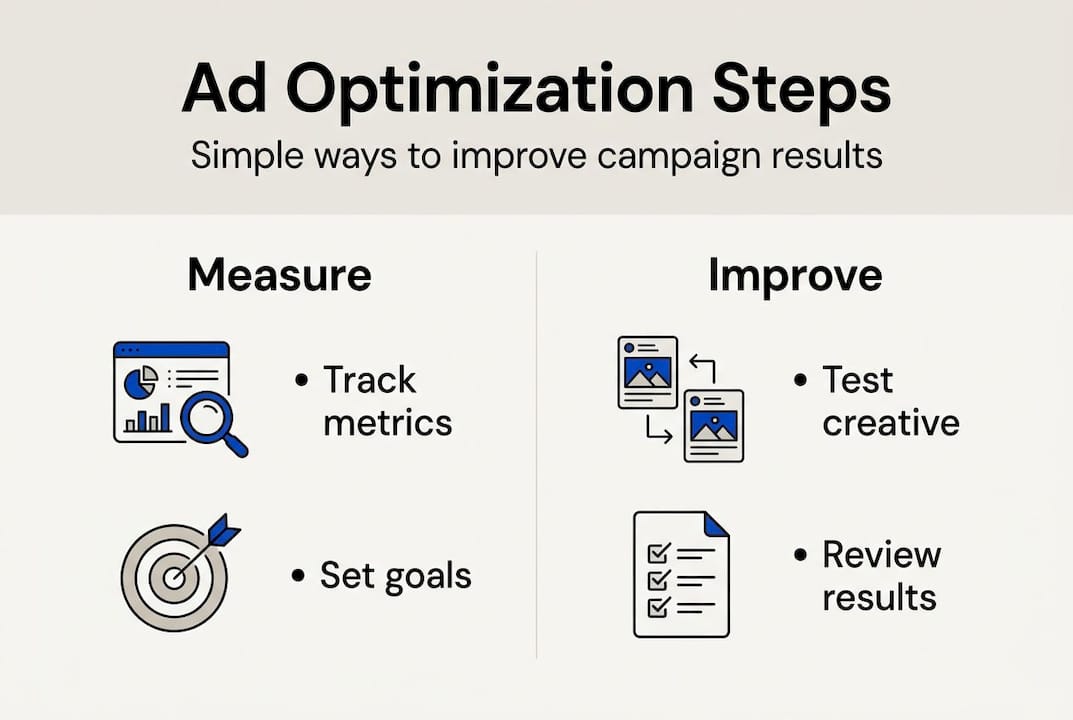
Pro Tip: Use your analytics platform to run A/B tests on your landing pages at the same time you’re running ad creative tests. Optimizing both simultaneously compounds your conversion gains faster than testing either one alone.
Here’s the uncomfortable truth most ad guides won’t say out loud: a bigger budget does not fix a broken creative strategy. We’ve seen brands pour five figures a month into campaigns built on copy-paste templates and wonder why their ROAS keeps dropping. Templates give you a starting point, not a winning ad. What actually moves the needle is a relentless focus on the specific person you’re selling to and a willingness to test, kill, and iterate without ego.
After four years of A/B tests, funnel audits, and heatmap analysis, the pattern is clear. Brands that fail to analyze their funnel holistically keep optimizing the wrong thing. They fix the ad when the landing page is broken. They redesign the landing page when the offer is weak. Real conversion growth comes from treating every touchpoint as part of one connected system, not isolated pieces. The conversion struggle case study we’ve documented shows exactly how this plays out across different brand categories.
Effective ads are built on continuous learning. The brands winning in 2026 are the ones treating creative as a testing engine, not a one-time production.
If you’ve worked through this guide and you’re ready to stop guessing and start converting, Blue Bagels builds the creative assets that make it happen. Our ad CRO services cover everything from direct response copy and video scripts to full funnel strategy, all grounded in four years of real testing data. We don’t do pretty for the sake of pretty. We build ads and pages that are engineered to sell.
You can browse our display ad results to see what performance-focused creative actually looks like in practice. And if you want to understand the full scope of what we do, the CRO agency home is the best place to start. Let’s turn your ad spend into revenue.
A high-converting ad in eCommerce typically achieves a conversion rate above the platform average, often exceeding 3 to 5%. Direct response ads built around specific offers and audience pain points consistently outperform brand-awareness creative.
Use A/B testing and targeted content to improve user experience and reduce friction, with a focus on clear calls to action and message consistency with your ad. Landing page optimization is one of the highest-leverage moves you can make after your ads are live.
Popular tools include Google Analytics, Meta Ads Manager, and custom eCommerce dashboards that give you deep conversion insights at the ad and audience level. Structured analytics use reduces campaign errors by 30% and accelerates conversion growth.
Avoid cluttered visuals, weak or multiple CTAs, and launching without testing variations. These issues consistently suppress conversion rates and make it impossible to identify what’s actually working in your campaigns.
