.png)

Founder testimonials achieve a 62% hook rate, outperforming polished production by nearly 40%. If your health brand is still pouring budget into cinematic video shoots and studio-quality brand assets, you may be paying a premium for creative that actually converts less. The most effective direct response ad creative for health brands blends compliance, trust, and behavioral psychology into a tight, repeatable structure. This guide breaks down the frameworks, compliance rules, and creative tactics that move the needle without putting your brand at risk.
| Point | Details |
|---|---|
| Trust-first creative wins | Authentic stories and visuals drive more engagement than polished production in health brand DR ads. |
| Compliance is critical | Stick to scientifically backed, structure/function claims to avoid regulatory risk and bans. |
| CTAs must be immediate | Clear, urgent calls to action deliver higher conversion in direct response advertising. |
| Rotate creative often | Switch up creative weekly and tailor CTAs for retargeted vs. new audiences to beat fatigue. |
Health brand advertising operates under a different set of rules than general DTC. You are not just selling a product. You are asking someone to trust you with their body, their family, or their health outcomes. That raises the stakes on every creative decision you make.
The most effective direct response (DR) ads in health follow a clear sequence: identify a relatable problem fast, build visual trust immediately, and deliver a persuasive call to action (CTA) before attention drops. Generic lifestyle imagery does not do this. Real people do.
Short-form video boosts engagement by 28%, and video outperforms static creative by 60% in health categories. These are not marginal gains. They represent a fundamental shift in how your audience wants to receive information and build trust.
Here is what separates high-converting health ad creative from the rest:
The winning framework is: Hook, Problem, Solution, Proof, CTA. Every element earns its place. Nothing is decorative.
| Creative element | High-performing approach | Low-performing approach |
|---|---|---|
| Hook | Founder story or real result | Brand logo animation |
| Problem | Specific pain point (e.g., bloating) | Vague wellness language |
| Solution | Mechanism story with clear benefit | Product feature list |
| Proof | Real testimonials, clinical backing | Stock photos, generic reviews |
| CTA | Specific and urgent | “Shop Now” with no context |
A medical CRO case study from our own client work shows how restructuring creative around this framework drove measurable lifts in both click-through rate and conversion. The data is consistent: structure beats polish every time.
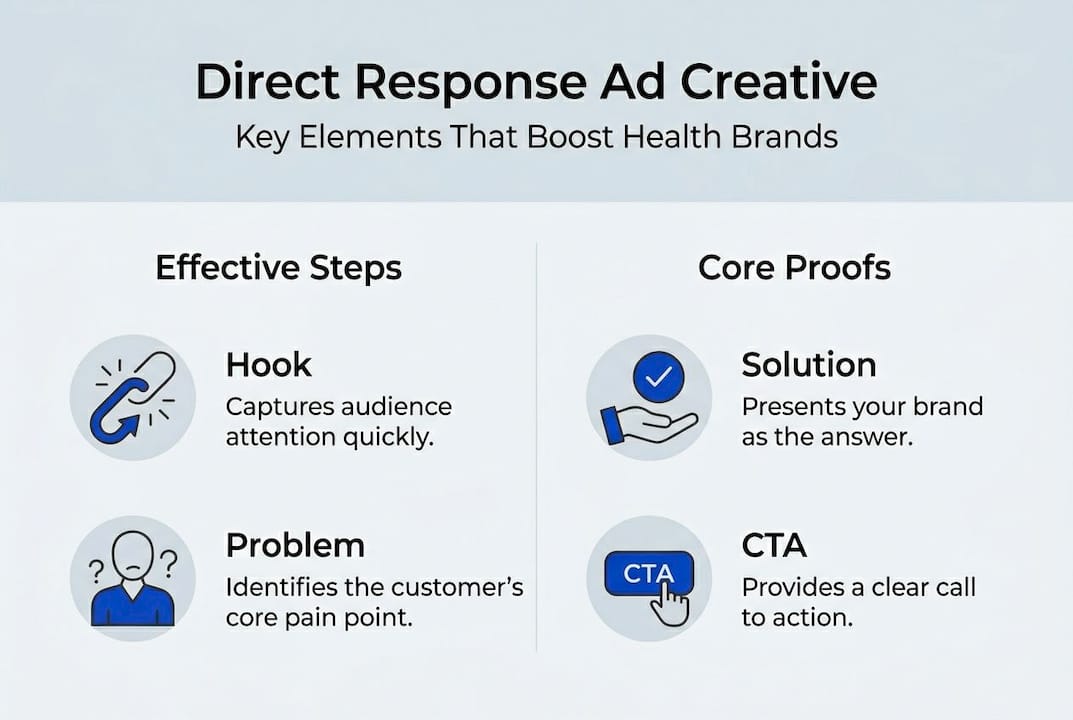
The best-performing DR ads follow a clear, repeatable structure. In health advertising, that structure needs to do double duty: it must convert and it must comply. Here is how to build it step by step.
Step-by-step ad framework for health brands:
The comparison below shows how health brand ad frameworks differ from general DTC:
| Framework element | Health brand approach | General DTC approach |
|---|---|---|
| Hook | Specific result or social proof | Lifestyle aspiration |
| Problem | Clinical or physical symptom | Desire or inconvenience |
| Solution | Mechanism-based explanation | Product features |
| Proof | Clinical data or real testimonials | Influencer endorsement |
| CTA | Trial, subscription, or consultation | Purchase or browse |
Our ads CRO frameworks are built around this exact structure, refined through four years of testing across health, supplement, and wellness brands.
Pro Tip: Avoid vague hooks. Specify who, what, or how in the first 3 seconds. “This gut protocol helped 10,000 women over 40” is infinitely stronger than “Feel better today.”
This is where most health brands either get it right and scale, or get it wrong and face consequences that no creative budget can fix. Compliance is not a legal footnote. It is a core part of your creative strategy.
The FTC requires “competent and reliable scientific evidence” for any health claim and prohibits unqualified disease cure statements. That means if your ad says your supplement “cures IBS” or “reverses diabetes,” you are not just risking a bad review. You are risking a federal enforcement action.
The safe zone is structure/function claims. These describe how a product supports a normal body function rather than treating or curing a disease. Examples:
FTC compliance is not a constraint on your creative. It is protection for your brand. Overclaims and rule violations can get brands banned from platforms, hit with fines, and stripped of the consumer trust they spent years building.
Testimonials carry their own compliance requirements. Results shown must be representative of what a typical customer can expect, or you must clearly disclose that results are not typical. “I lost 40 lbs in 30 days” without a disclaimer is a liability, not a selling point.
Only use health claims backed by randomized controlled trials (RCTs) or strong peer-reviewed scientific evidence. If your supplier provides a certificate of analysis, that is not the same as clinical proof. Know the difference before your creative goes live.
Polished production signals budget. Authentic content signals truth. In health advertising, truth wins.

Trust-first and authentic UGC and founder-led creative outperforms polished brand content by 40%. That gap is not closing. As consumers become more skeptical of health marketing, the brands that lead with real voices are pulling further ahead.
Here is what authentic creative looks like in practice:
An authentic creative case study from our portfolio shows how a children’s health brand shifted from polished lifestyle video to parent-led UGC and saw a significant drop in cost per acquisition. The creative looked less expensive. It performed far better.
You can also see conversion uplift examples across multiple health categories where authentic storytelling consistently outperformed traditional brand creative.
Pro Tip: Rotate testimonials and human stories regularly. Wellness fatigue is real. The same founder video that crushed it in week one will flatline by week four. Build a content rotation system from day one.
If you want to see where your current creative stands, a free CRO audit can identify exactly which elements are costing you conversions.
A great hook and a compelling story mean nothing if your CTA does not close. In health advertising, the CTA has to do three things at once: create urgency, feel trustworthy, and stay compliant.
CTAs like “Walk In Now” and “Check In Online” perform best when paired with credible proof. The CTA is not just a button. It is the final moment of persuasion in your ad sequence.
Urgency drivers that work in health advertising:
Here is a simple CTA sequence that converts:
One critical distinction most brands miss: your cold traffic CTA and your retargeting CTA should never be the same. Cold audiences need low-commitment entry points. “Start my free trial” or “Take the quiz” reduces friction for someone who has never heard of you. Warm audiences who already visited your high-converting landing pages need a different push. “Try again today” or “Pick up where you left off” acknowledges their prior interest and removes the hesitation.
Pro Tip: Separate your retargeting CTAs from your cold campaign CTAs. “Try Again Today” speaks to someone who already considered buying. “Start My Trial” speaks to someone discovering you for the first time. Mixing them up is one of the most common reasons brands struggle to scale, as detailed in our breakdown of brand scaling challenges.
Rotate your creative and update your CTA framing every two to three weeks. Our supplement CRO results show that fresh creative framing, even with the same core offer, consistently reactivates audience segments that had gone cold.
Now that you are equipped to sharpen every aspect of your ad creative, here is how to accelerate results with the right support. Knowing the framework is one thing. Executing it with speed, precision, and a testing infrastructure behind every decision is another.
At Blue Bagels, our ads CRO services are built specifically for health and DTC brands that need creative to perform, not just look good. We produce direct response ad copy, UGC scripts, video ads, advertorials, and landing pages, all grounded in four years of real testing data. You can review ad performance case studies across health, supplement, and wellness categories to see exactly what we have built and what it delivered. If you are ready to find out what is holding your current creative back, visit Blue Bagels and request a free audit. We will show you where the gaps are and how to close them fast.
Trust-building visuals featuring real people and a compliance-safe, specific CTA are the two elements that most directly drive conversion in health advertising.
Stick to structure/function claims backed by scientific evidence and avoid disease cure statements that the FTC prohibits without qualified clinical proof.
UGC and founder content achieves a 62% hook rate because it signals authenticity, which health buyers prioritize over production quality when making purchase decisions.
Rotate creatives every two to three weeks and use separate messaging for retargeting. Warm traffic retargeting can drive up to 65% repeat business when paired with fresh, relevant creative framing.
