.png)

TL;DR:
- Most e-commerce landing pages have low conversion rates, often below 3 percent.
- Optimizing message match, attention ratio, and mobile experience significantly boosts conversions.
- Continuous, structured testing is essential for sustained and measurable improvement in conversion rates.
Most e-commerce founders pour money into paid traffic and watch their analytics with growing frustration. Visitors arrive, scroll a bit, and leave. The average e-commerce landing page converts between 1.8% and 3% of visitors, which means 97 out of every 100 people you pay to reach walk away empty-handed. High intent traffic does not automatically equal leads. The gap between clicks and conversions is almost always a structural problem, not a traffic problem. This article walks you through four proven, actionable steps to close that gap and lift your lead conversion rates with evidence-backed CRO techniques.
| Point | Details |
|---|---|
| Know your baseline | Measuring your current conversion rates and traffic sources sets the stage for targeted improvements. |
| Match landing page messaging | Alignment between ads, emails, and landing page content builds trust and reduces bounce rates. |
| Test copy and CTAs | Simple A/B tests and value-focused CTAs can drive dramatic uplifts in conversion rate. |
| Focus on mobile performance | Speed and responsive design are vital as mobile dominates traffic and often lags in conversion. |
| Commit to ongoing CRO | Continuous optimization and experimentation make the difference between stagnant and high-performing brands. |
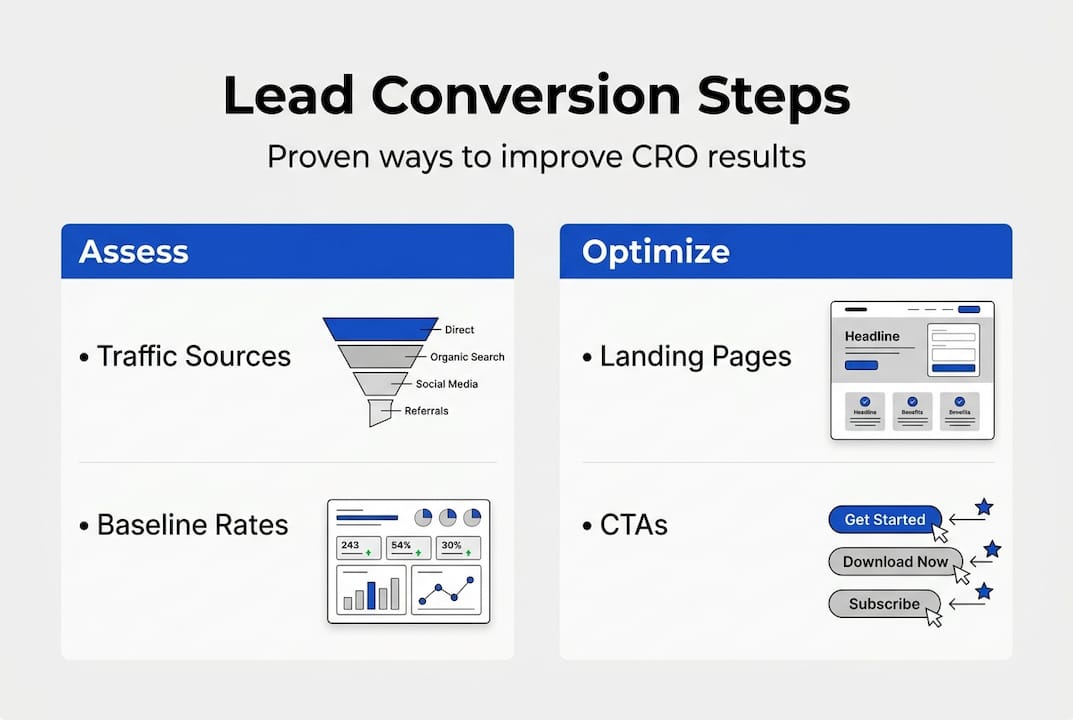
Before you change a single headline or button color, you need to know exactly where you stand. Skipping this step is like trying to fix a leak without knowing which pipe is broken.
Start by pulling your landing page data from Google Analytics or whatever analytics platform you use. Look at three core numbers for each page: sessions, goal completions, and conversion rate. Then compare what you find against e-commerce conversion benchmarks to understand whether you have a minor gap or a major one.
Here is a simple tracking table to map your baseline:
| Page | Monthly traffic | Conversions | Conversion rate | Bounce rate |
|---|---|---|---|---|
| Homepage | 10,000 | 180 | 1.8% | 62% |
| Product landing page | 4,500 | 135 | 3.0% | 48% |
| Lead capture page | 2,200 | 33 | 1.5% | 71% |
Once you have this data, segment it by device. Mobile and desktop visitors behave differently, and a page that performs well on desktop can be a conversion killer on mobile. Next, look at traffic sources. Paid traffic from Meta or Google often arrives with higher intent than organic, but it also has higher expectations for message relevance.
Key areas to audit before you start testing:
Understanding these conversion barriers early saves you from optimizing the wrong things. A solid conversion optimization guide can also help you build a repeatable audit process.
Pro Tip: Do not obsess over raw traffic volume. A page converting at 5% with 1,000 visitors outperforms a page converting at 1% with 8,000 visitors. Conversion rate is the metric that actually moves revenue.
Once your baseline is documented, you have a clear starting point. Every test you run from here is measured against this snapshot, which is what makes improvement visible and repeatable. Make sure to also explore different landing page test types to understand which experiments are worth running first.
With your baseline in hand, it is time to make direct changes to how your landing pages engage and convert visitors. The two highest-leverage moves at this stage are message match and attention ratio.

Message match means the headline and offer on your landing page mirror the ad or email that brought the visitor there. If your ad promises “50% off your first order” and your landing page opens with a generic brand tagline, you have broken the visitor’s mental thread. They feel confused, not compelled. That confusion costs you conversions.
Attention ratio refers to the number of links and actions available on a page versus the one action you actually want the visitor to take. A typical website page with navigation, footer links, and sidebar content might have 30 or more clickable elements. A high-converting landing page should have one. Research confirms that removing navigation links consistently leads to higher conversion rates because it eliminates distraction.
| Page type | Average conversion rate |
|---|---|
| Standard page with navigation | 1.9% |
| Dedicated landing page, no navigation | 3.8% |
| Personalized landing page, no navigation | 5.2% |
Here is how to tighten message match and attention ratio in a structured way:
“The best landing pages feel like a seamless continuation of the ad. The visitor should never feel like they clicked somewhere unexpected.” This is the standard every page should be held to.
You can see how navigation limiting results plays out in real campaigns. For practical visual examples, the message match examples section shows how aligned creative performs across different verticals. HubSpot’s resource on lead capture design also covers structural principles worth applying.
Now that the basic structure is optimized for message and focus, the next stage targets the actual content: copy, headlines, and calls to action. This is where most of the conversion leverage lives, and it is also where most brands underinvest.
Your headline is the first thing a visitor reads and the primary factor in whether they keep reading. A weak headline can sink an otherwise solid page. Testing headlines is one of the fastest ways to generate a measurable lift. One A/B testing case study showed a 104% month-over-month increase in conversions from headline changes alone. That is not a small gain from a minor tweak.
Copy improvements to prioritize right now:
Personalization takes this further. Personalized CTAs convert up to 202% better than generic ones. That number sounds extreme, but it makes sense when you consider that a returning visitor and a first-time visitor have completely different needs. Showing each of them the same CTA is a missed opportunity.
Pro Tip: Always start your testing with the headline before touching anything else. It is the highest-impact element on the page and gives you the clearest signal about what your audience actually responds to.
You can apply these principles across your ad CRO techniques as well, since the copy rules that work on landing pages translate directly to ad creative. The personalization case study shows how dynamic content lifted conversion for a children’s brand. For deeper guidance, HubSpot’s landing page copywriting resource covers the fundamentals well.
Copy and content are vital, but most e-commerce traffic now arrives via mobile, making device optimization a must. The numbers here are hard to ignore. Mobile traffic represents 71% to 83% of landing page visits, yet mobile conversion rates consistently trail desktop by a significant margin. You are sending the majority of your visitors to an experience that is statistically less likely to convert.
Mobile CRO steps that move the needle:
Page speed is the single most controllable factor in mobile conversion. Slow pages bleed visitors before they even see your offer.
| Device | Average conversion rate | Recommended load time |
|---|---|---|
| Desktop | 3.9% | Under 3 seconds |
| Tablet | 3.2% | Under 3 seconds |
| Mobile | 2.0% | Under 2 seconds |
Pro Tip: Aim for a mobile page load time under three seconds. Use Google PageSpeed Insights to identify exactly what is slowing your pages down. Even a one-second improvement can lift mobile conversions by 7% or more.
The mobile CRO test types that tend to deliver the fastest results include speed tests, button size tests, and form length tests. If you want a full audit of your landing page mobile optimization, reviewing your current setup against these benchmarks is a strong starting point.
Here is something worth saying plainly: most brands that struggle with conversion are not missing a tactic. They are missing a process.
The conventional approach is to find a “hack,” apply it once, and expect permanent results. That is not how conversion rate optimization works. The brands that consistently outperform their benchmarks are the ones running structured, ongoing experiments. Not one test per quarter. Ongoing, systematic testing with clear hypotheses and documented results.
CRO case studies consistently show sustained lifts of 23% to 41% in conversion rates, but those results come from 90-day programs of iterative testing, not a single change. The brands winning at conversion treat every page as a living experiment, not a finished product.
The uncomfortable truth is that most teams do not have the bandwidth or the testing infrastructure to do this well internally. That is not a failure. It is a resource reality. The answer is not to do less testing. It is to build a system, or find a partner, that makes continuous testing sustainable. Understanding why scaling conversion stalls for most brands often comes down to this exact gap. You can see what sustained optimization looks like in practice through conversion uplift examples from brands that committed to the process.
If you have worked through these steps and you are ready to move from planning to execution, Blue Bagels can accelerate that process. We bring four years of hands-on CRO experience to every engagement, backed by real testing data, heatmaps, and funnel audits that tell us exactly where your conversions are leaking. Our CRO ads services cover everything from direct response ad creative to full-funnel strategy, and our landing page optimization work is built specifically to turn ad spend into measurable revenue. If you want to see what that looks like in practice, our real-world CRO results show the kind of lifts that come from treating conversion as a discipline, not a one-time project.
Most e-commerce landing pages convert between 1.8% and 3% of visitors, and anything consistently above 3% is considered strong performance for the industry.
Measurable lifts can appear within weeks of launching an A/B test, with case studies showing 23–41% improvement in conversion rates over a 90-day testing program.
Extremely important. Mobile accounts for 71–83% of landing page traffic but converts at a lower rate than desktop, making mobile speed and design a top priority.
Yes, significantly. Personalized CTAs convert up to 202% better than generic ones, making dynamic personalization one of the highest-return changes you can make to a landing page.
