.png)

Most DTC founders treat growth marketing and performance marketing as the same thing. They’re not. Performance marketing gets you clicks and conversions today. Growth marketing builds the engine that keeps customers coming back, spending more, and telling their friends. The brands scaling past eight figures aren’t just running better ads. They’re running smarter full-funnel systems built on experimentation, behavioral data, and relentless iteration. This guide breaks down exactly what growth marketing is, which frameworks actually work for eCommerce and DTC, and how to combine it with performance marketing to maximize both short-term ROAS and long-term revenue.
| Point | Details |
|---|---|
| Growth marketing foundations | Growth marketing uses data-driven experiments across the entire customer journey, not just acquisition. |
| Frameworks matter | The AARRR and RARRA frameworks help DTC brands diagnose and optimize every stage of the funnel. |
| Tactical execution | Frequent creative testing and retention flows deliver measurable lifts in conversion and profitability. |
| Combining strategies | Integrating growth and performance marketing maximizes both short- and long-term ROI for eCommerce brands. |
| Real-world impact | Applying growth marketing repeatedly leads to sustainable, scalable results for DTC and eCommerce companies. |
Traditional marketing runs a campaign, measures impressions, and calls it a day. Growth marketing never calls it a day. It’s a data-driven, iterative approach that uses experimentation across the full customer lifecycle to achieve sustainable growth, rather than relying on static campaigns that reset every quarter.
The difference shows up fast in eCommerce. Traditional marketing might nail your Black Friday acquisition numbers. Growth marketing asks what happens after the purchase. Did those customers come back? Did they refer anyone? Did your onboarding flow convert first-time buyers into loyal repeat customers? Those questions are where real revenue lives.
Here’s a quick breakdown of how the two approaches compare:
| Factor | Traditional marketing | Growth marketing |
|---|---|---|
| Strategy type | Fixed campaigns | Iterative experiments |
| Funnel focus | Top-of-funnel only | Full lifecycle |
| Decision basis | Intuition and brand feel | Data and testing |
| Goal | Awareness and reach | Retention and LTV |
| Measurement | Impressions, reach | ROAS, CAC, LTV, RPR |
For growth marketing for DTC brands specifically, the iterative model is a natural fit. Your customer data is rich, your feedback loops are fast, and your margins depend on repeat purchases, not just first-order revenue.
The core advantages of growth marketing for eCommerce include:
“Growth marketing treats every touchpoint as a testable variable, not a fixed creative decision.”
If you want to see what this looks like in practice, the growth strategy case study from a children’s brand shows how full-funnel thinking drives results that paid-only campaigns simply can’t replicate.
Now that we’ve drawn the distinction, let’s get into the frameworks that power growth marketing. The most widely used is AARRR, and for good reason.
The AARRR framework stands for Acquisition, Activation, Retention, Referral, and Revenue. It gives you a structured way to diagnose exactly where your funnel is leaking and prioritize fixes by impact.
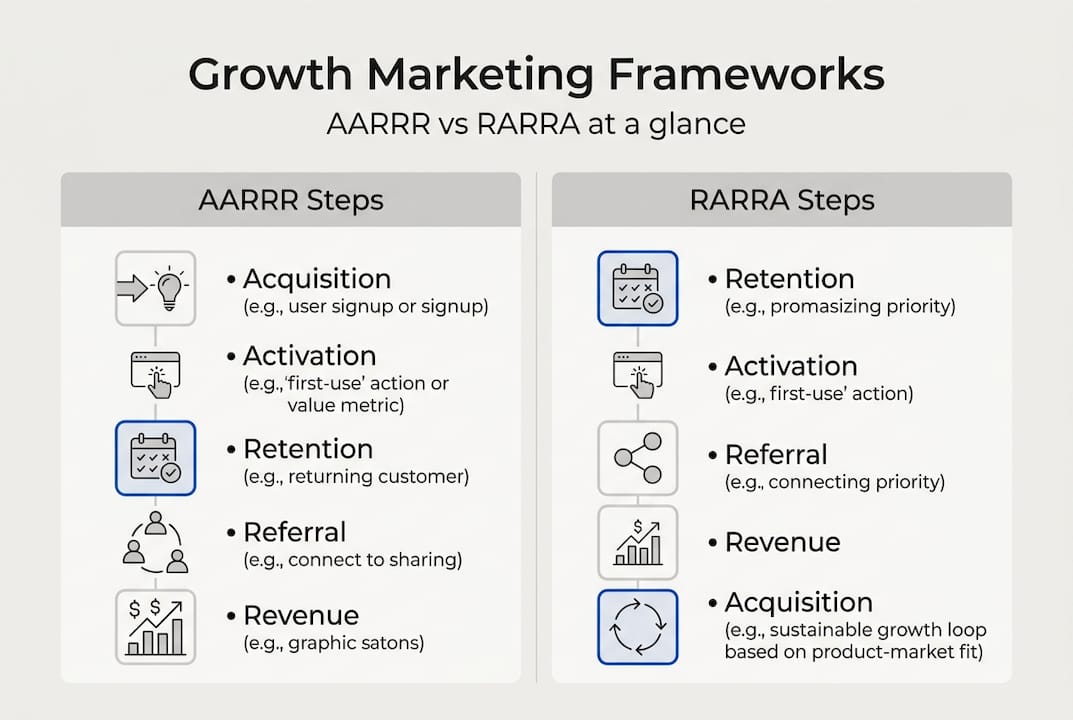
Here’s how each stage maps to eCommerce and DTC:
| Stage | What it means for DTC | Example metric |
|---|---|---|
| Acquisition | Getting traffic to your store | CPC, CPM, CTR |
| Activation | First meaningful action (first purchase, email opt-in) | Conversion rate |
| Retention | Repeat purchases, subscription renewals | RPR, churn rate |
| Referral | Word-of-mouth, affiliate, UGC | Referral rate, NPS |
| Revenue | Total value extracted per customer | LTV, AOV |
Here’s how to use AARRR as a diagnostic tool:
For example, if your activation rate is low, the problem might be your onboarding email sequence or your post-purchase page. Layering in abandoned cart retention tactics at the retention stage can dramatically lift repeat purchase rates without touching your ad spend at all.
Now, RARRA flips the priority order: Retention, Activation, Referral, Revenue, Acquisition. The RARRA overview explains why some brands benefit from leading with retention rather than acquisition.
Pro Tip: If your brand has been running for more than two years and your LTV is strong, RARRA is worth serious consideration. Acquiring new customers when your retention is broken is like filling a leaky bucket. Fix the leak first. See how a retention-first approach played out for one brand that stopped chasing acquisition and started compounding retention instead.
For a real-world AARRR use case, a supplement brand used the framework to identify that their activation stage was the bottleneck. Their traffic was strong. Their conversion rate was the problem. One landing page test later, revenue jumped without increasing ad spend.
With frameworks in hand, let’s get tactical and look at what real growth marketing execution looks like.
The engine of growth marketing is experimentation. Not guessing. Not going with your gut. Running structured tests, reading the data, and making decisions based on what actually happened. The mechanics of growth marketing include A/B testing, personalization, and rapid experimentation across every customer touchpoint.

For eCommerce brands running paid social, creative testing is the highest-leverage activity you can do. Brands that test 20 or more creatives per month consistently see Meta ROAS above 4x. That’s not a coincidence. More tests mean more winners, and winners scale.
Here’s a repeatable creative testing process:
Beyond ads, growth marketing tactics include:
Pro Tip: During low-competition ad periods (think January or post-Q4), manual campaigns often outperform automated bidding strategies. Algorithms optimize for volume. When volume is low, manual control gives you precision that automated systems can’t match.
If you’re not sure where your funnel is losing money, use a structured audit to identify conversion bottlenecks before you scale spend. Scaling a broken funnel just means losing money faster.
After seeing the core tactics, it’s vital to understand how growth and performance marketing can be integrated, not just compared.
Performance marketing is built for speed. You run paid campaigns, optimize for ROAS and CPA, and measure results in days. It’s powerful. But it rents customers. The moment you stop spending, the traffic stops. Growth marketing, on the other hand, builds full-funnel, long-term systems that improve LTV and retention over time.
| Factor | Performance marketing | Growth marketing |
|---|---|---|
| Time horizon | Short-term | Long-term |
| Primary metric | ROAS, CPA | LTV, RPR, CAC payback |
| Customer relationship | Transactional | Relational |
| Budget dependency | High (stops when spend stops) | Lower over time |
| Best for | Quick revenue spikes | Sustainable scaling |
The best DTC brands don’t choose between the two. They blend them. Performance marketing funds growth. Growth marketing makes performance marketing more efficient.
Here’s how to think about the budget mix:
“The brands winning in 2026 aren’t spending more on ads. They’re making every dollar work harder through smarter retention and lifecycle systems.”
If you’re serious about scaling with growth marketing, the integration of both disciplines is non-negotiable. Performance without growth is a treadmill. Growth without performance is too slow. Together, they compound.
Let’s bring all these concepts together with examples and repeatable strategies you can implement today.
Start with diagnosis. Use the AARRR framework to identify bottlenecks in your funnel. Most brands find their biggest leak at activation or retention, not acquisition. Fixing those stages first means your existing ad spend immediately becomes more efficient.
Here’s a step-by-step growth marketing process for DTC brands:
Key takeaways by growth stage:
| Stage | Tactic | Expected impact |
|---|---|---|
| Acquisition | Test 20 or more creatives per month | Meta ROAS above 4x |
| Activation | Optimize onboarding and post-purchase page | Conversion rate lift |
| Retention | Abandoned cart and winback flows | Up to 3x RPR lift |
| Referral | UGC and referral program | Lower CAC |
| Revenue | AOV optimization, bundles, upsells | LTV increase |
For DTC growth marketing tips that go deeper, the brands seeing the best results are the ones treating every creative, every email, and every page as a testable asset. Nothing is sacred. Everything is a variable. Browse the CRO case studies to see how this plays out across different product categories and funnel types.
You’ve got the frameworks. You know the tactics. Now the question is execution. That’s where most brands stall. They understand growth marketing in theory but lack the creative infrastructure to run real experiments at scale. Blue Bagels exists to close that gap. We build the direct response ad creative, landing pages, presell pages, and retention flows that make growth marketing actually work. If you’re ready to optimize ad performance with creative built for conversion, not just aesthetics, we can help. See DTC success stories from brands that have already made the shift. Or start with a free CRO audit to find out exactly where your funnel is leaking money right now.
Growth marketing is full-funnel and focused on long-term metrics like LTV and retention, while performance marketing targets short-term paid conversions measured by ROAS and CPA. Both matter, but they serve different time horizons.
The AARRR framework covers Acquisition, Activation, Retention, Referral, and Revenue. Each stage represents a distinct part of the customer journey that can be diagnosed and optimized independently.
RARRA prioritizes retention over acquisition and works best for mature DTC brands where customer lifetime value is high and the cost of acquiring new customers outweighs the return from fixing retention leaks.
Testing 20 or more creatives per month is the benchmark for brands achieving Meta ROAS above 4x. More creative volume means more data, more winners, and more efficient scaling.
Abandoned cart sequences, post-purchase emails, and winback campaigns are the three core retention flows. Brands that implement all three consistently see repeat purchase rates lift by up to 3x compared to brands relying on acquisition alone.
