.png)

TL;DR:
- AI-powered testing provides near-instant insights, reducing testing cycles from weeks to hours.
- It automates hypothesis generation, dynamic traffic allocation, and real-time analysis for scalable CRO.
- Combining AI with human strategy yields the best results, especially for high-stakes or complex purchases.
Most e-commerce and DTC brands still treat CRO testing like a slow, manual process: write a hypothesis, set up a variant, wait 2 to 4 weeks, analyze results, repeat. That loop is expensive and slow. AI-powered testing delivers immediate results compared to those traditional timelines, and the brands that figure this out first are pulling ahead fast. This article breaks down exactly how AI-powered testing works, what you should actually be testing, what the real benchmarks look like, and where the limits are so you can build a smarter, faster CRO engine without getting burned by hype.
| Point | Details |
|---|---|
| AI speeds up CRO | AI-powered testing delivers instant CRO insights compared to weeks-long manual methods. |
| Higher conversion lifts | Brands see 15-40% conversion improvements and strong ROI by deploying AI for website and ad testing. |
| Optimize with hybrid strategy | Pair AI automation with human strategic input and phased rollouts for best performance. |
| Address AI limitations | Mitigate variance and bias in AI-powered tests with larger sample sizes and variance reduction techniques. |
| Apply across e-commerce | AI can optimize headlines, images, CTAs, layouts, and checkout flows for DTC and e-commerce brands. |
AI-powered testing is not just A/B testing with a fancier dashboard. At its core, machine learning and automation for CRO includes autonomous A/B testing, multivariate testing, and real-time decision making that no human team could replicate at scale. The system learns from user behavior continuously, adjusting which variants get traffic based on live performance data rather than waiting for a test to “complete.”
The mechanics are more sophisticated than most people realize. Continuous behavior monitoring, automatic hypothesis generation, Bayesian statistical analysis, and dynamic traffic allocation all run simultaneously. Bayesian analysis, for example, updates probability estimates in real time rather than waiting for a fixed sample size. That means you get actionable signals faster without sacrificing statistical rigor.
Here is how AI-powered testing compares to the manual approach most teams are still running:
| Feature | Manual testing | AI-powered testing |
|---|---|---|
| Hypothesis generation | Human-led, slow | Automated, continuous |
| Traffic allocation | Fixed split | Dynamic, performance-based |
| Time to first result | 2 to 4 weeks | Near-instant |
| Multivariate capacity | Limited | High, scales easily |
| Statistical method | Frequentist | Bayesian, real-time |
The key components that make AI testing work include:
“AI-powered testing revolutionizes e-commerce CRO by removing the bottlenecks of manual setup, slow cycles, and limited test capacity, replacing them with a system that learns and optimizes around the clock.”
If you want to understand the full range of what you can test, the types of landing page tests available to e-commerce brands go well beyond basic A/B. And pairing that knowledge with solid e-commerce analytics insights gives you the behavioral foundation AI needs to generate meaningful hypotheses.
Knowing the mechanics is one thing. Seeing what actually gets tested, and what results come back, is where strategy gets real. AI tests headlines, images, CTAs, layouts, product recommendations, and checkout flows for e-commerce uplift, which covers most of the high-leverage touchpoints in a DTC funnel.
The most common AI CRO test targets for e-commerce brands include:
The case study data is compelling. Conversion rates increased by 6.35% and add-to-cart rates rose 18.9% for Dorko and Whiskynet respectively using AI-driven personalization and testing. These are not marginal gains. An 18.9% lift in add-to-cart rate is the kind of number that changes a brand’s unit economics.
| Test type | Manual lift (avg) | AI-powered lift (avg) | Time to result |
|---|---|---|---|
| Headline variants | 3 to 5% | 8 to 15% | Days vs. weeks |
| Checkout flow | 4 to 7% | 10 to 20% | Near-instant |
| CTA optimization | 2 to 4% | 6 to 12% | Days |
| Product recommendations | 5 to 8% | 12 to 22% | Real-time |
Pro Tip: Focus your first AI-powered tests on checkout flows, CTAs, and product recommendations. These three areas have the highest revenue impact per test and the clearest behavioral signals for AI to work with.
For brands running paid traffic, the connection between high-converting ads techniques and on-site testing is critical. Your static ads and landing page variants need to be tested as a system, not in isolation.
Let’s get specific about what the numbers actually look like. AI delivers conversion improvements of 15 to 40%, with tests running instantly compared to 2 to 4 weeks for manual methods. That speed advantage alone changes how you plan sprints, allocate budget, and respond to seasonal shifts.
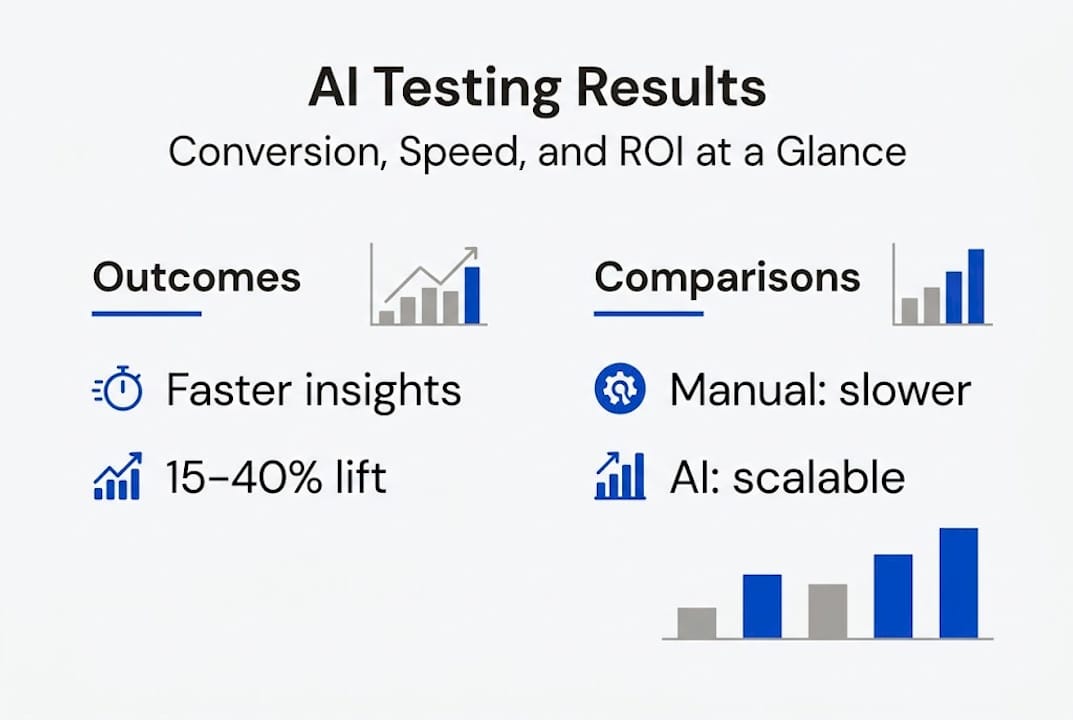
Statistic to know: AI-powered testing delivers 15 to 40% conversion improvements across e-commerce funnels, while compressing testing cycles from weeks to hours.
But here is a nuance that most articles skip. For ad creatives, AI increases CTR by 12% on Meta but decreases conversions by 8% for high-AOV products. A higher click-through rate does not automatically mean more revenue. For high-ticket items, the creative that gets clicks is not always the creative that closes the sale.
| Metric | Manual CRO | AI-powered CRO |
|---|---|---|
| Avg. conversion lift | 3 to 8% | 15 to 40% |
| Time to first result | 2 to 4 weeks | Hours to days |
| Test capacity per month | 2 to 5 | 20 to 50+ |
| ROI on testing investment | Moderate | High (with right setup) |
| High-AOV conversion risk | Low | Moderate |
The top reasons brands adopt AI-powered testing include:
For brands serious about full funnel optimization, AI testing is not optional anymore. And if you are working to improve lead conversion at the top of the funnel, faster testing cycles mean faster learning on what messaging actually resonates.
AI testing is not a magic switch. Before you hand your CRO program over to an algorithm, you need to understand where it breaks down.
AI testing requires 5x bigger sample sizes, novelty bias decays after burn-in, and excels with low-AOV direct-response but can struggle with high-consideration purchases. Novelty bias means users interact differently with a new variant simply because it is new, not because it is better. That effect fades, but if your test window is too short, you will call a winner based on inflated early numbers.
Non-determinism is another real challenge. AI systems do not always produce the same output given the same input, which makes replication harder and variance higher. This is not a dealbreaker, but it does mean your testing infrastructure needs to account for it.
Proven mitigation strategies include:
Pro Tip: Always use larger audiences and phased rollouts when testing AI-generated variants. Starting with 10 to 20% of traffic and scaling up after burn-in protects you from novelty bias and inflated early results.
“AI is not a universal win. For high-consideration purchases, trust-driven categories, or low-traffic stores, hybrid human-AI models consistently outperform fully automated approaches.”
Hybrid human-AI models with variance reduction techniques like CUPED and phased testing are the current best practice for reliability and performance. Pair your conversion growth analytics with a clear marketing funnel framework to make sure AI has the right signals to work with.
After four years of running A/B tests, funnel audits, and creative experiments for e-commerce and DTC brands, here is the honest take: AI is an incredible tool for volume and iteration, but it is not a strategist.
AI-powered testing unlocks fast, scalable improvements but strategic input is essential for trust-intensive or high-AOV campaigns. We have seen brands chase AI-generated CTR wins that actually hurt their conversion rates on $200+ products because the creative optimized for curiosity clicks, not buyer intent.
The conventional wisdom that AI just makes everything better is wrong. What AI does well is run more tests faster and reallocate traffic intelligently. What it does not do well is understand brand voice, buyer psychology for complex purchases, or the emotional arc of a high-stakes buying decision. Those require human judgment.
The brands winning right now are using AI for the heavy lifting, running volume, finding signals, and iterating fast, while humans set the strategic objectives, define the audience segments, and interpret results in context. Start with clear goals and behavioral data. Use AI to accelerate toward those goals, not to define them. Our ad optimization services are built on exactly this hybrid model.
If this article has made one thing clear, it is that AI-powered testing is only as good as the creative and strategic foundation underneath it. At Blue Bagels, we combine four years of hands-on CRO experience with direct response creative that is built to be tested. Our ads CRO services are designed for e-commerce and DTC brands that want faster learning cycles and higher-converting funnels, not just prettier assets. Browse our static ads solutions to see how we build creative that feeds your testing engine, and check out our display case studies to see real results from brands like yours.
AI-powered testing automates hypothesis generation and traffic allocation for faster, scalable CRO, whereas traditional A/B testing relies on manual setup and slower cycles. The result is more tests, faster signals, and continuous optimization without human bottlenecks.
AI tests headlines, images, CTAs, layouts, product recommendations, and checkout flows to optimize conversion and revenue. Essentially, any element a user interacts with on your site or ad is a candidate for AI-driven testing.
While AI is faster and often delivers stronger conversion lifts, hybrid human-AI models outperform fully automated approaches for high-stakes or low-traffic campaigns. A hybrid strategy is the safest and most effective approach for most brands.
AI testing inflates variance and novelty bias, requiring phased rollouts and variance reduction techniques like CUPED for reliable results. Brands that skip these safeguards often misread early test data and scale losing variants.
AI delivers immediate results versus the 2 to 4 week cycle typical of manual testing. Most brands see actionable data within hours to days, depending on traffic volume and test complexity.