.png)

TL;DR:
- Focus on diagnosing and fixing key funnel drop-offs to improve overall conversion rates.
- Optimize landing pages for speed, clarity, and trust signals to reduce user friction.
- Continuous testing and iteration across creative, targeting, and pages sustain measurable growth.
You’re spending more on ads every month, but your conversion rate (CVR) sits stubbornly at the same number. Sound familiar? Rising CPMs across Meta and TikTok mean every percentage point of CVR improvement is worth more than it’s ever been. The brands winning right now aren’t just outspending competitors, they’re outconverting them. This guide walks you through a proven, step-by-step process to diagnose funnel leaks, fix your landing pages, sharpen your ad creative, and build a testing habit that compounds gains over time. Every tactic here is grounded in real case study data, not guesswork.
| Point | Details |
|---|---|
| Pinpoint funnel leaks | Use analytics to identify exactly where shoppers drop off for targeted fixes. |
| Prioritize mobile optimization | Speed and simple mobile experiences lead to higher conversion rates and revenue. |
| Iterate on ads and landing pages | Regular testing and fast feedback loops maximize ROI from your digital spend. |
| Data-driven improvements | Case studies show 41%+ CVR gains are achievable by following a structured approach. |
Most conversion losses don’t happen at checkout. They happen earlier, quietly, at stages most teams never bother to audit. A visitor lands on your page, scrolls halfway, and leaves. Another adds to cart and vanishes at the shipping screen. Without funnel diagnostics, you’re optimizing blind.
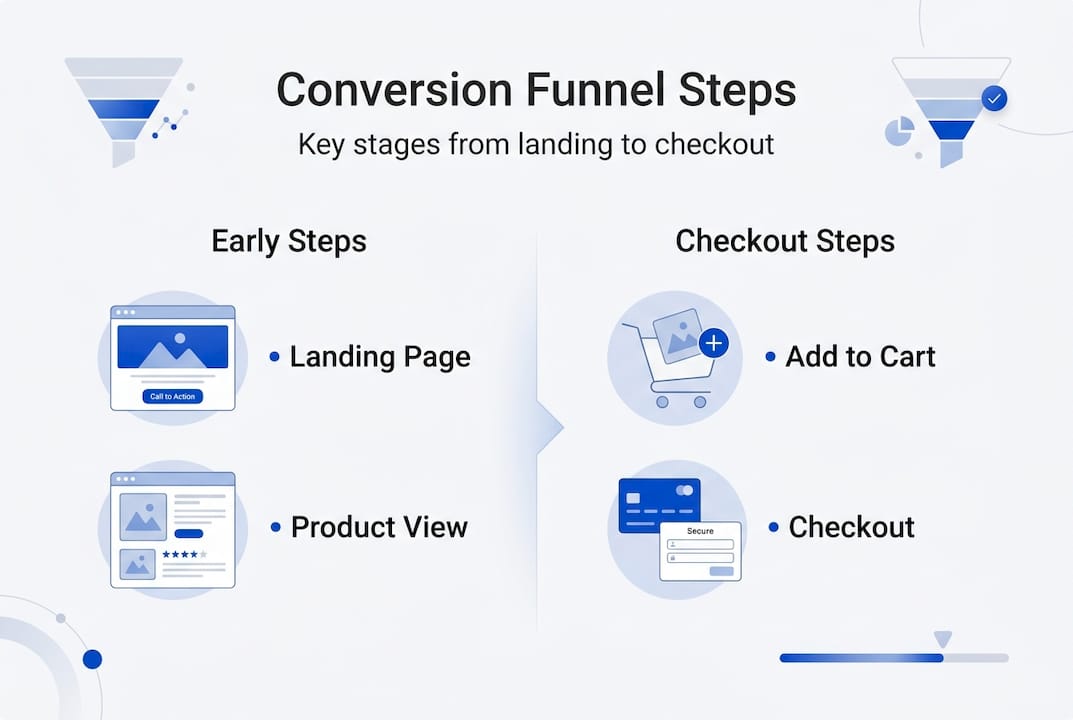
Start by pulling data from your analytics platform on four core stages: landing page, product detail views, cart additions, and checkout initiations. Map your actual drop-off percentages at each stage. This tells you exactly where to focus first, because fixing a 70% drop-off at the landing page will always beat obsessing over a 10% checkout abandonment rate.
Segmenting by device is non-negotiable. Mobile and desktop users behave very differently, and a funnel that converts well on desktop can be completely broken on mobile. Pull your CVR by device type and look for gaps larger than 1.5 percentage points. That gap is money left on the table.
Here’s a quick benchmark table to compare your current funnel metrics:
| Funnel stage | Typical drop-off rate | Your current rate |
|---|---|---|
| Landing page bounce | 40-60% | __ |
| Product page to cart | 60-75% | __ |
| Cart to checkout | 50-65% | __ |
| Checkout to purchase | 20-40% | __ |
Once you’ve mapped your numbers, prioritize stages where you’re underperforming the benchmark by 10 or more points. Those are your quick wins.
Key areas to review during your funnel audit:
Real results back this up. A structured funnel optimization approach helped one online collectibles store achieve a 41% CVR increase from 1.28% to 1.81% in just 90 days, driven by mobile enhancements and focused funnel analytics.
Pro Tip: Tag every funnel event in your analytics with descriptive names like “cart_add_pdp” or “checkout_step2_shipping” so you can isolate exactly where users drop. Vague event names slow diagnosis by days.
Once you’ve flagged your weakest funnel points, it’s time to streamline those pages for top performance. Landing pages are where ad spend meets reality. A slow, cluttered, or confusing page will undo every dollar you spent getting someone there.
Load speed is the first thing to fix. Every additional second of load time increases bounce rates meaningfully. On mobile, users are especially unforgiving. If your page takes more than three seconds to load, a significant portion of your paid traffic never even sees your offer.

Here’s a before-and-after comparison of what targeted landing page improvements typically produce:
| Element | Before optimization | After optimization |
|---|---|---|
| Mobile load time | 5.2 seconds | 2.1 seconds |
| Above-fold CTA visibility | Below scroll | First screen |
| Mobile CVR | 0.9% | 1.27% |
| Average order value (AOV) | $48 | $61 |
Those numbers aren’t hypothetical. After a Shopify migration and speed optimizations, Florasoul saw a 41% mobile CVR lift alongside a 28% increase in AOV. Speed and clarity compound each other.
Follow this sequence when auditing your landing pages:
If you’re unsure where to start, focus on improving landing pages for your top-spending ad campaigns first. That’s where the ROI on your CRO effort is highest.
Pro Tip: Design and test mobile-first. Mobile traffic often represents 60-70% of paid traffic for DTC brands, so a mobile CVR lift delivers the fastest ROI improvement of any single optimization.
With high-performing landing pages in place, your next opportunity is maximizing the match between your traffic and your offer. Even a perfect landing page can’t save a campaign where the ad creative attracts the wrong audience or sets the wrong expectation.
Creative-to-offer mismatch is one of the most common and most expensive conversion killers. If your ad promises a discount and the landing page doesn’t lead with it, you’ve already lost the visitor’s trust. Consistency between what the ad says and what the page delivers is the foundation of a high-converting funnel.
A/B testing your creative is not optional, it’s ongoing. Test one variable at a time: the hook, the visual format (static vs. video), the headline, or the offer framing. Document every test result so you build institutional knowledge instead of repeating the same experiments.
Targeting tweaks that consistently move the needle:
The data speaks clearly. The same CRO framework that produced a CVR jump from 1.28% to 1.81% also relied on tighter audience alignment to make sure the right traffic reached the optimized pages.
“The creative is only as good as the audience it reaches and the page it sends them to. Optimize all three together, or you’re leaving serious money behind.”
For practical guidance on execution, explore ad creative techniques built specifically for e-commerce, or look at how direct response ad creative drives measurable results. If static ads are part of your mix, static ad improvements can often deliver faster iteration cycles than video.
To make your conversion lift stick and keep momentum, embed these testing and improvement habits in your team. One-off optimizations fade. A repeatable testing cycle compounds.
The biggest mistake brands make is treating CRO as a project rather than a practice. You fix the landing page, see a bump, and move on. Three months later, CVR drifts back down because the market shifted, creative got stale, or a competitor improved their offer. Continuous testing is what separates brands that sustain 3% CVR from those that bounce between 1% and 2%.
How to structure your testing cycle:
A common error is pulling test results too early. A test that looks like a winner on day three can flip by day ten. Patience here directly protects your revenue. Also, always segment results by device. A change that lifts desktop CVR by 15% might actually hurt mobile CVR, which is the larger segment.
For lead conversion CRO and e-commerce funnels alike, the principle holds: test volume and rigor determine outcome quality. Florasoul’s 28% AOV increase came from a disciplined iteration process, not a single lucky change.
Pro Tip: Prioritize tests on pages with the most traffic first. A 10% lift on a page with 10,000 monthly visitors beats a 30% lift on a page with 500. Volume is what makes test results reliable and impactful.
When a test fails, don’t discard it. Instead:
If you want to accelerate this process, ads CRO services can provide the infrastructure and expertise to run more tests, faster.
Here’s what four years of funnel audits, heatmaps, and A/B tests have taught us: most brands don’t fail at CRO because they lack knowledge. They fail because they chase best practices instead of solving for their specific audience’s real friction points.
You can follow every checklist in existence and still plateau at 1.5% CVR if you’re not actually watching how your users behave on your pages. Best practices are starting points, not answers. The brands we’ve seen break through to 3% and beyond are the ones treating every test as a learning, not a lottery ticket.
The other pattern we see constantly is teams drawing conclusions from insufficient data. They run a test for five days, declare a winner, and move on. Then they wonder why the gains don’t hold. Statistical rigor is not optional if you want results that last.
Cross-device thinking matters more than most teams realize. Why most brands struggle to scale often comes down to optimizing for desktop behavior while most of their revenue opportunity sits on mobile. Fix that mismatch first.
If you’re ready to boost your conversions faster and get hands-on support, here’s how we can help. At Blue Bagels, we’ve spent four years building and testing the exact assets that move conversion numbers: landing pages, ad creative, presell pages, and full funnel strategies grounded in real data. If you want to skip the trial-and-error phase and get to results faster, our ads performance services cover everything from creative testing to audience strategy. For brands that need stronger pages, our landing page optimization work is built around the same diagnostic and iteration process outlined in this guide. Book a consult and let’s look at your funnel together.
A good e-commerce CVR in 2026 typically falls between 2% and 4%, though top-performing DTC stores in competitive niches regularly exceed that range through consistent CRO work.
Targeted CRO tests can show measurable movement in 2 to 3 weeks, but meaningful gains like the 41% CVR increase achieved in 90 days require a sustained, structured approach.
Start with page speed and above-fold CTA visibility, then layer in mobile-specific UX improvements. Florasoul’s 41% mobile CVR lift came directly from speed optimization and Shopify migration, not design overhauls.
Check your bounce rate and exit rate at the landing page step in your analytics. If users are leaving before reaching the product or cart stage, your page is the bottleneck, not your ads.