.png)

TL;DR:
- Most ecommerce brands lack a clear, stage-specific funnel guiding customer decisions.
- Optimizing each funnel stage with tailored messaging and creative improves conversions.
- Continuous testing and data-driven adjustments are essential for successful funnel performance.
Most ecommerce founders are running tactics, not a strategy. They’re spending on Meta ads, testing landing pages, sending email blasts, and wondering why revenue feels unpredictable. The missing piece is almost always the same: a clear, intentional ecommerce funnel. Not the buzzword version you’ve heard at marketing conferences, but a real, stage-by-stage system that moves strangers into buyers and buyers into loyal customers. This guide breaks down exactly what an ecommerce funnel is, how each stage works, where most brands leak money, and what you can do today to make yours convert harder.
| Point | Details |
|---|---|
| Funnel clarifies the journey | Mapping your ecommerce funnel reveals exactly where potential customers drop off so you can intervene. |
| Stage-specific strategies win | Tailoring creative assets and messaging to each funnel stage dramatically increases conversions. |
| Analytics fuel growth | Using analytics platforms helps you spot leaks and optimize performance across the funnel. |
| Avoid common pitfalls | Mistakes like inconsistent messaging derail funnels, while best practices lead to reliable sales growth. |
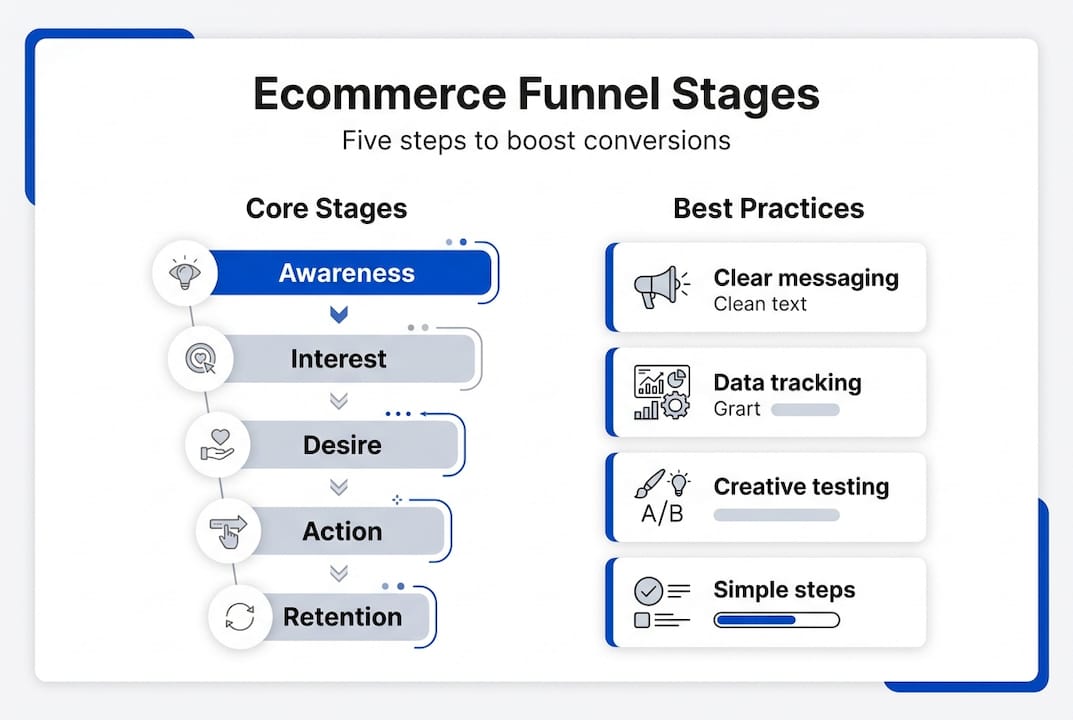
An ecommerce funnel is the structured path a potential customer travels from first hearing about your brand to making a purchase and ideally coming back again. Think of it as a map of your customer’s decision-making journey. At the top, you have a wide audience who barely knows you exist. At the bottom, you have buyers who trust you enough to hand over their credit card. The funnel narrows at each stage because not everyone who discovers you will buy, and that’s completely normal.
The classic framework most marketers use is AIDA plus Retention:
| Funnel stage | Goal | Key KPI |
|---|---|---|
| Awareness | Get discovered | Reach, impressions, CPM |
| Interest | Earn attention | CTR, time on site, video views |
| Desire | Build want | Add-to-cart rate, email signups |
| Action | Drive purchase | Conversion rate, ROAS |
| Retention | Maximize LTV | Repeat purchase rate, AOV |
Each stage has a different job. Awareness creative should stop the scroll. Interest content should educate and intrigue. Desire messaging should make the product feel essential. Action pages should remove friction. Retention flows should reward loyalty and trigger repurchase.
Understanding where each stage begins and ends gives you something most brands never have: clarity on why their numbers look the way they do. Full funnel optimization significantly increases conversions and ROAS because it forces you to treat each stage as its own discipline.
Top benefits of mapping your ecommerce funnel:
“Brands that understand and optimize every funnel stage consistently outperform those running disconnected campaigns, often doubling conversion rates within a single quarter.”
The funnel is not a set-it-and-forget-it structure. It’s a living system that needs regular attention, testing, and refinement.

Knowing the stages is one thing. Knowing what to actually do at each stage is where most founders get stuck. Here’s a practical breakdown:
Awareness. Your audience doesn’t know you yet. Your job is to interrupt their scroll with something worth stopping for. This means bold creative, a strong hook, and a clear value proposition in the first three seconds. Think short-form video ads on TikTok or Meta that lead with a problem your product solves. A skincare brand, for example, might open with “Why does your moisturizer stop working after 30 days?” to immediately grab attention from the right people.
Interest. The prospect clicked. Now you need to hold them. This is where your landing page, advertorial, or presell page does the heavy lifting. You’re not selling yet. You’re educating, storytelling, and building credibility. High-converting ad examples show that proven techniques in digital ads move customers efficiently through each funnel stage when the messaging matches their current level of awareness.
Desire. The prospect understands what you offer. Now they need to want it. Social proof, before-and-after results, UGC, and comparison content all work here. This is where retargeting ads earn their keep. Static ad strategies are especially effective at this stage because they can showcase testimonials and product benefits in a format that’s easy to absorb.
Action. The purchase decision. Your product page, checkout flow, and offer structure need to eliminate every possible reason to hesitate. Urgency, clear guarantees, and frictionless checkout are non-negotiable here.
Retention. The sale is not the finish line. Post-purchase email flows, loyalty programs, and cross-sell sequences are what separate brands with healthy margins from those constantly chasing cold traffic. Scaling with funnels requires building retention into the system from day one, not as an afterthought.
Pro Tip: The most common mistake founders make is using the same creative and messaging across all funnel stages. A cold audience ad should look and sound completely different from a retargeting ad. Treating them the same is one of the fastest ways to burn budget.
Optimizing your funnel isn’t about overhauling everything at once. It’s about identifying your biggest leak and plugging it first. Here’s where to start:
Quick-win optimizations by funnel stage:
Creative asset impact by funnel stage:
| Creative type | Best funnel stage | Primary goal |
|---|---|---|
| Short-form video | Awareness | Stop the scroll |
| Advertorial / presell page | Interest | Educate and warm up |
| UGC and testimonials | Desire | Build trust |
| Product page / offer | Action | Convert |
| Email sequence | Retention | Repurchase |
Using analytics for funnel growth is how you move from guessing to knowing. Analytics technologies help brands achieve up to 30% fewer errors in tracking conversion growth, which means you’re making decisions based on real data, not gut feel.
Pro Tip: The single most underused creative tweak is adding a direct response headline to your product images. Most brands use lifestyle photos with no copy. Drop a bold benefit statement or a social proof stat directly on the image and watch your click-through rate climb.
Even brands with solid products and real budgets make funnel mistakes that quietly kill their results. Here are the ones we see most often:
Most common funnel-killing mistakes:
Inconsistent messaging is one of the most common ways marketers undermine their own funnels, along with a lack of lead nurturing between stages. The prospect who saw your awareness ad needs a different conversation than the one who already visited your product page twice.
Best practices that actually move the needle:
“Brands that implement structured funnel management with consistent follow-up and stage-specific messaging see measurable lifts in conversion rates, often within the first 30 days of changes.”
A real example: one DTC supplement brand was running awareness ads directly to a product page and wondering why their ROAS was tanking. After adding a presell page between the ad and the product page, their conversion rate increased by over 40% in the first month. The product didn’t change. The funnel did.
The marketing funnel advantages become obvious once you stop treating your funnel as a straight line and start treating it as a conversation that evolves at every stage. Lead conversion CRO steps give you the tactical playbook to make that conversation more persuasive at every touchpoint.
Here’s the uncomfortable truth we’ve learned after four years of funnel audits and creative testing: most ecommerce funnels don’t fail because of bad tools or wrong platforms. They fail because founders treat the funnel as a one-time setup instead of an ongoing creative experiment.
Every guide you’ll read focuses on which software to use or which platform to run ads on. That’s the wrong conversation. The real question is: does your creative and messaging actually match where your customer is in their decision journey? In our experience, the answer is usually no.
Founders overcomplicate their funnels by adding more stages, more tools, and more automations. But a simple funnel that’s tested relentlessly will always outperform a complex one that’s been ignored. The brands struggling to scale almost always have the same problem: they built the funnel and walked away.
Our advice: audit your funnel for dead spots. These are the stages where customer intent is high but your messaging goes silent or generic. Find those gaps, inject stage-specific creative, and test your way to better numbers.
If you’ve read this far, you already understand more about funnel strategy than most founders running paid ads today. The next step is putting that understanding to work. At Blue Bagels, we specialize in building the creative assets that make every funnel stage perform. From high-converting ad creative that stops cold audiences cold to landing page optimization that turns warm traffic into buyers, we cover the full funnel. We also offer static ad support for brands that need scroll-stopping creative at the desire and retargeting stages. Book a call with our team and let’s find where your funnel is leaking revenue.
The main stages are Awareness, Interest, Desire, Action, and Retention. Each stage requires different messaging, creative formats, and KPIs to move prospects forward effectively.
Optimizing each stage targets the specific bottlenecks where prospects drop off, leading to higher conversion rates and better ROAS. Full funnel optimization significantly increases conversions by aligning creative and messaging to each stage of the buyer journey.
Analytics platforms monitor customer movement and conversion drops across every funnel stage. Analytics technologies reduce conversion tracking errors by 30%, giving brands cleaner data to make smarter decisions.
The biggest mistake is using the same messaging and creatives across all funnel stages. Inconsistent messaging is one of the primary ways marketers undermine funnel performance and leave conversions on the table.